hexatess-code
Hexatess Code 🐝



An experimental 2D barcode on a hexagonal grid — with a hexagonal bullseye finder, spiral serialization and a continuously selectable Reed-Solomon error-correction budget of 5–90 %.
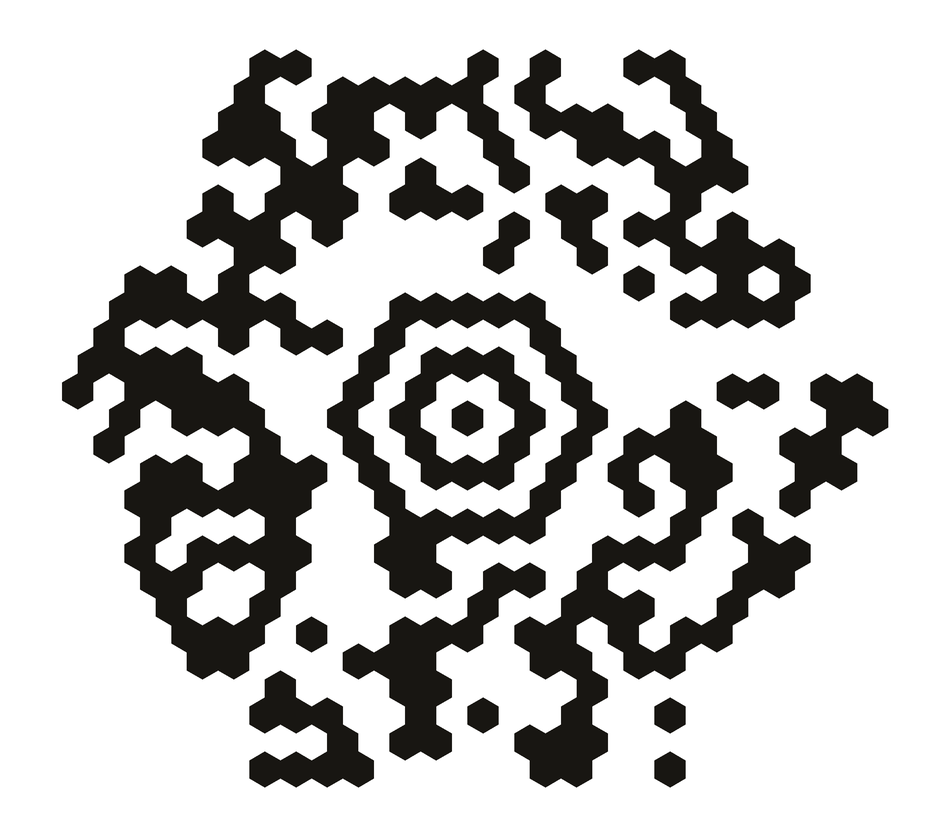
from hexatess import encode, decode, render

grid, params = encode("Hello, Hexatess!", ec_pct=30)
render(grid, "hello.png")
text, stats = decode(grid)          # ('Hello, Hexatess!', {...})
Symbol anatomy
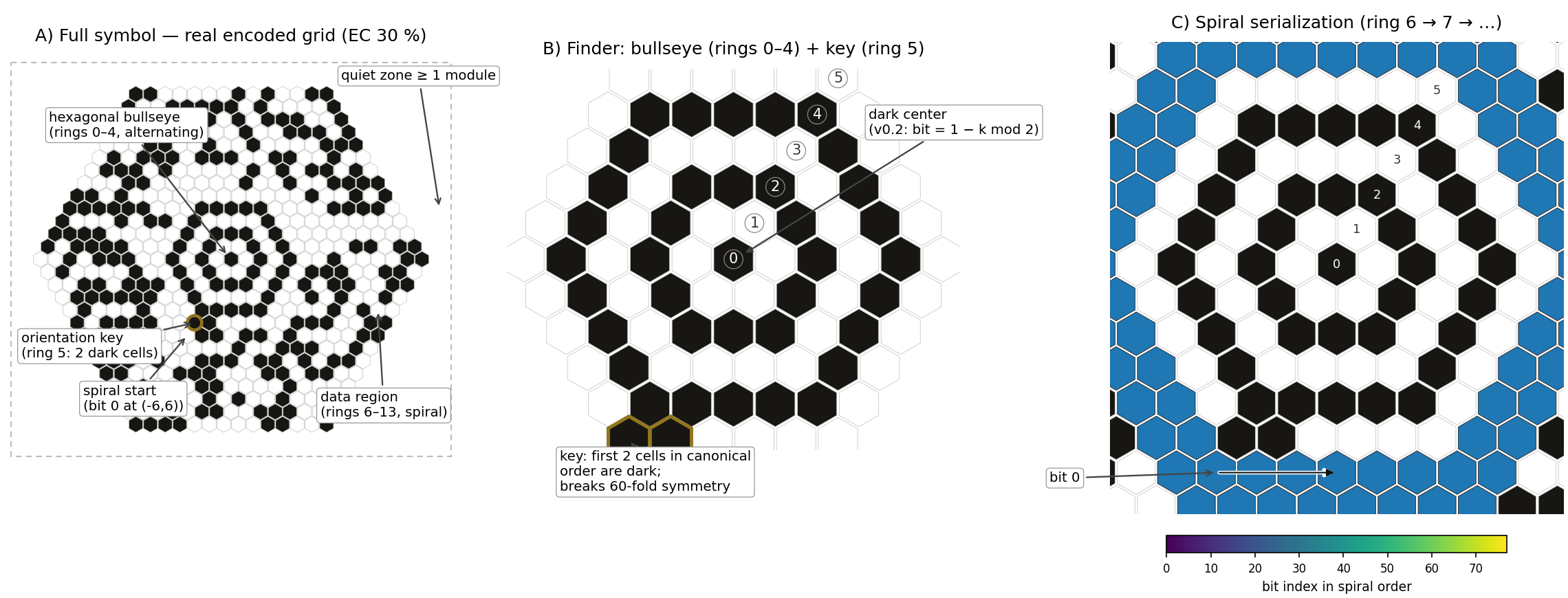
- A — a real encoded symbol: hexagonal bullseye finder (rings 0–4), orientation key (ring 5: two dark cells), data region (rings 6…) filled in spiral order, and a quiet zone of at least 1 module;
- B — finder close-up: dark centre (rule
bit = 1 − ring mod 2), alternating dark/light rings, and the key — the first two canonical ring-5 cells set dark, breaking the 60-fold symmetry and marking the spiral start direction; - C — spiral bit order across rings 6–7 (bit 0 at cell
(−6, +6)), rendered from the actual reference encoder output.
Why hexagons?
- +15.5 % packing density over the square grid — hexagons tile the plane with ~15.5 % more modules per area at equal module size, which directly translates into more data per printed area.
- Rotational isotropy — three axes of symmetry instead of two; damage from any direction is statistically equivalent.
- Proven heritage — MaxiCode (UPS, ISO/IEC 16023) already proved a hexagonal 2D code works in the field; Hexatess Code generalizes the idea to variable-size, high-capacity, Aztec-style symbols.
- Modern error control — continuous EC budget from 5 % to 90 % (not 7 discrete levels), independent RS blocks of ≤ 50 data bytes, and a double-protected header.
Status: experimental. This is a young format: the symbol specification and reference implementation are solid and heavily tested (2,500+ tests, conformance vectors). A camera decoder (
hexatess.camera, optional[camera]extra) already reads symbols from real photographs in about a second — printed labels, foil transparencies, tilted and rotated shots. Since spec v0.3 payload text is zlib-compressed automatically, so long texts fit into considerably smaller symbols. See the roadmap below. Adopting a young format is a deliberate bet; the full format specification is the insurance.
Installation
pip install hexatess-code            # from PyPI (once published)
pip install "hexatess-code[camera]"  # + photo decoding (numpy, opencv, scipy)
# or from a source checkout:
pip install -e .
Requires Python ≥ 3.8; Pillow for rendering, numpy + OpenCV + SciPy for the optional camera decoder.
Command line
hexatess "Hello world" -o koda.png --ec 30
hexatess "Important URL https://example.org" -o url.png --ec 55
hexatess --demo                       # demo symbol + robustness statistics
hexatess decode photo1.jpg photo2.jpg   # read symbols from images/photos
hexatess decode-photo photo1.jpg        # same as `decode`
Payload text is zlib-compressed automatically when that saves space
(--no-compress disables it; the header flag keeps decoders fully
backward compatible).
Payload compression (spec v0.3)
One header bit marks the payload as a zlib stream. The encoder applies it only when it strictly helps, and decoders inflate transparently — symbols without the flag are byte-identical to v0.2. What that means in practice (EC 30 unless noted):
| payload | raw | stored | symbol |
|---|---|---|---|
| 80 digits | 80 B | 21 B | rmax 17 → 11 |
"X" × 250 |
250 B | 12 B | rmax 30 → 10 |
| 849-byte Slovene paragraph | 849 B | 203 B | would not fit → rmax 28 |
| short strings (≤ ~30 B) | — | unchanged | overhead wins |
The maximum stored capacity is unchanged (329 bytes at EC 5), so incompressible data behaves exactly as before.
API
| Function | Description |
|---|---|
encode(text, ec_pct=30, mask_id="auto", min_rings=None, compress="auto") |
UTF-8 text → (grid, params); grid maps axial (q, r) to 0/1 |
decode(grid) |
grid → (text, stats); RS-corrects and inflates transparently |
render(grid, path, size_px=18, ...) |
grid → PNG (pointy-top hexagons, quiet zone, supersampling) |
sample_grid_from_image(path, rmax, ...) |
ideal re-sampling of a rendered PNG (self-test helper) |
run_tests(...) |
noise/blob robustness statistics |
hexatess.camera.decode_photo(path) |
photograph → (text, stats); finder detection, perspective handling, adaptive sampling (optional [camera] extra) |
params / stats contain rmax (radius in rings), mask, ec,
blocks (list of (data_bytes, ecc_bytes)), data_len (stored
length) and compressed; stats also reports repair_bits (the RS
correction ledger) and, for camera decodes, sector and
finder_hits.
Error-correction budget
Choose any multiple of 5 between 5 and 90:
| EC | Character |
|---|---|
| 5–15 | maximum capacity, clean environments |
| 25–40 | general use (default 30) |
| 50–70 | industrial / outdoor |
| 80–90 | extreme damage tolerance |
Physical behaviour (measured on the reference implementation): one
flipped module is one RS symbol error, so uniform-noise tolerance is
roughly EC / 16 percent of modules, while clustered (smudge/blob)
damage survives several times higher area fractions because flips
concentrate inside whole bytes.
Implement it in your own language
A pure-JavaScript encoder, decoder and image scanner already ship in
this repository — see javascript/ (zero dependencies,
byte-identical to the Python reference for uncompressed symbols) and
the browser playground demo.html at the repository root.
The playground encodes and decodes: it reads clean renders and
real photographs — uneven lighting, camera noise, blur, JPEG
artefacts, glare, arbitrary in-plane rotation and moderate perspective
are absorbed in pure JS (full-circle finder sweep, homography fit,
quadratic correction surface, RS erasure decoding). PNG files are
decoded without a canvas, so the page also works from file://.
Very small prints (a few pixels per cell) and extreme angles remain
with the Python camera pipeline.
The format is deliberately specification-first: everything needed
for an independent implementation is in
SPECIFICATION.md, and
test_vectors/vectors_v0.3.json
contains fixed inputs/outputs (grids, headers, damaged symbols, expected
results) to verify conformance. If your Rust/Go/JS decoder passes the
vectors, it speaks Hexatess Code.
Roadmap
v0.2/0.3 — camera decodingdone (v0.3.0):hexatess.camerareads symbols from photographs — bullseye detection, homography + correction-field warp handling, adaptive sampling; validated on printed foil with curl and glare. v0.3.1: ≈10× faster (a typical 12 MP photo now takes about a second) plus stable outer-ring sampling and mis-decode-proof pose selection.v0.3 — payload compressiondone (v0.3.1): zlib flag bit in the header, applied automatically when it helps.- Erasure decoding: declare blob-occluded modules as erasures → doubles correctable symbol counts.
- JavaScript/TypeScript SDK + online playground (generate a code
in the browser in 10 seconds) — encoder, decoder and image
scanner done:
javascript/+demo.html; hosted playground (GitHub Pages) next. - Larger radii / capacity beyond 329 stored bytes (breaking header change).
Contributions welcome — see CONTRIBUTING.md.
License
- Code: MIT
- Specification: CC-BY-4.0 — implement it anywhere, commercially, under any license, no royalties, forever.
Hexatess Code stands on the shoulders of giants: Aztec Code (bullseye + spiral), MaxiCode (hexagonal lattice), QR Code and Data Matrix (Reed-Solomon practice).